

There is a scene in I Love Lucy that every church communicator knows by heart, even if they have never seen it.
Lucy and Ethel take a job wrapping chocolates on a conveyor belt. The rule is simple: don't let a single piece get by unwrapped. Then the belt speeds up. They wrap faster. It speeds up again. Soon they are stuffing chocolates in their mouths, their hats, and their blouses, doing anything to hide the fact that the line has beaten them. They are working as hard as two people can work, and they are losing badly.
That is what communications feels like in a lot of churches. Not because the team is slow or careless (they are usually neither), but because there are no controls on the belt. The requests keep coming (by text, by hallway, by "hey, real quick after service"), and the only plan anyone has is to move faster.
Here is the hard part hiding under the comedy: you can't out-hustle a conveyor belt. Effort does not fix a flow problem. Without a system, nothing you do scales, and you never get to control your own time. You just get better at stuffing chocolates in your hat.
The surprising part is that the belt does not speed up because there is too much work. Churches with tiny output feel just as frantic as churches with huge output. The belt speeds up because requests outnumber decisions, and that gap is where the chaos lives.
Every request smuggles in a dozen decisions
"Can you promote the men's breakfast?" sounds like one task. It is actually a stack of undecided questions: Who is it for? What do they need to know? Which channels? By when? Who approves it? What gets bumped to make room? When none of those are decided, the communications person does not just do the work. They absorb the ambiguity. Multiply that by every ministry, every week, and you get a job where the actual craft happens in the leftover minutes between negotiations.
In a church, every chocolate has a face
There is a wrinkle that makes church communications harder than the factory ever was. In the factory, the chocolates are just chocolates. In your church, every piece on the belt has a face. The flyer belongs to a volunteer who has been praying over this ministry for a year. The retreat video belongs to a leader you sit next to on Sunday. So when you say "I can't get to your flyer this week," it does not land as a scheduling note. It lands as "your ministry matters less than someone else's." Business and relationship are braided together, and that braid is what makes the work feel political.
This is why goodwill alone can't carry it. As long as the schedule is negotiated relationship by relationship, every deadline becomes a referendum on how much you value a person. A system is not there to make the church less relational. It is there to protect those relationships by lifting the schedule off of them, so you can manage deadlines and deliverables instead of feelings and influence. A shared path lets you say "here is where your project fits" instead of "here is what I think of you."
Three controls for the belt
This is a system problem, and that is good news, because system problems have system solutions. There is no button that fixes it overnight. There are three controls you can put on the belt, and together they change the whole job.
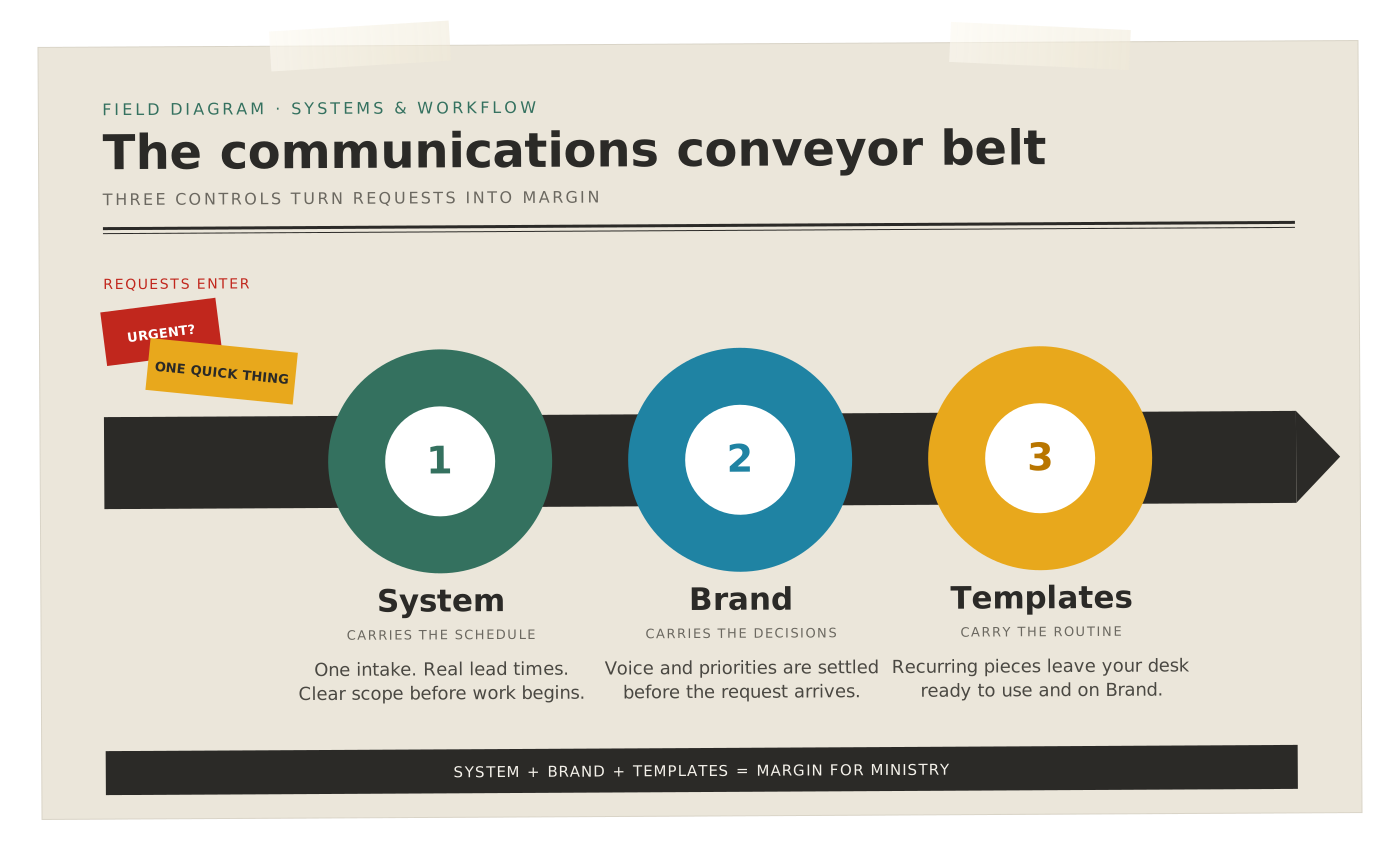
A system that runs the schedule, not the relationships. Right now the schedule lives in relationships: who asked, how loudly, how recently, how senior. That is why it feels political and never ends. A real workflow moves the calendar out of relationships and into a shared path: one intake for every request, real deadlines built from real channel lead times, and a published description of what the team does and does not do. When the system holds the schedule, a legitimate request finally has a path that is not your inbox, and you stop being both the bottleneck and the bad guy.
Part of that path is naming the work accurately. When every request is called a "project" (or just an "urgent"), you can't sequence any of it, because you can't tell a season-long campaign from a thirty-minute task. Give the work a real shape: campaigns hold projects, projects hold deliverables, and deliverables hold tasks. Christmas is a campaign. The invite card inside it is a deliverable. Once a request has a name and a size, the calendar can hold it, and "can you promote the men's breakfast?" stops being a vague obligation and becomes a deliverable with a due date and a place in line. (I made this case in Stop Calling Everything a Project.)
Brand that does the heavy lifting. An intentional Brand is a stack of decisions you already made, so no new piece starts from zero. The deeper questions are settled in advance: who we are, who we are called to serve, what story we are stewarding, and what should feel consistent across every touchpoint. Branding standards then carry the visible and verbal pieces: color, type, voice, hierarchy, templates, and routine design choices. That means most of the "which one matters more" fights never start. (That is the referee doing its job. I wrote about it in Brand Is the Referee.) A strong Brand is also the thing that makes help possible. Without a clear Brand and branding system, outsourcing backfires, because managing a freelancer with no standard to point to costs you more than doing the work yourself. With one, you hand them the standard instead of your attention.
Templates so every department can wrap its own chocolates. Not everything needs to touch your desk. When you build strong, on-brand templates (a Canva set for the easy, recurring pieces), ministries can make the simple things themselves and stay aligned with the Brand without you standing over their shoulder. You stop being the branding police, and the belt gets lighter, because half the chocolates never reach your station in the first place.
What the calm is for
None of this is about doing more. It is about getting your best work back. When the system carries the schedule, Brand carries the decisions, and templates carry the routine, the frantic belt finally slows down. What it leaves behind is margin, and margin is where the ministry lives: the story only your church can tell, the guest who needs to feel welcomed long before they reach a door, the good idea you have never had time to have.
You did not take this job to wrap chocolates faster. You took it to help people meet God. A healthy system hands your creativity back to you, with the room to spend it on the work only you can do.