Every church has a God-given story worth telling.
Before our future congregation hears a sermon or meets the pastor, before we ever know their names, they have already begun to experience our church:
- As they drive past our campus.
- As they navigate our website.
- As they scroll our social posts, watch a video, see a sign, or notice a photograph.
Each moment feels small on its own. Together they tell a story: about what matters here, about whether a person like them belongs, and about what God might be inviting them into.
That is why communication is not support work. It is ministry. It is one of the first ways we care for people, long before we know who they are.
I've spent more than twenty years in creative and technical arts, working in the space between the tech booth, the design desk, and the platform. Across those years I keep returning to a handful of convictions about how we shepherd the stories God has given us to tell. What follows is the framework I keep coming back to.
Communication is stewardship
The Gospel has always moved through ordinary things: letters, sermons, songs, and shared meals. Each one carried the message because someone cared enough to prepare it well.
That is still our work. Every email, website, photograph, announcement, video, and hallway conversation helps people understand who we really are, what we really believe, and how they can respond. None of it is neutral. Communication is the ongoing work of carrying the story clearly, through every interaction.
And carrying something entrusted to you is stewardship. The story is not ours to invent or inflate. It is ours to tend. When we shepherd these moments well, we make room for people to receive the message.
Story is the true thing, not the shiny thing
When I say story, I do not mean a more flattering version of your church. Story is not spin, and it is not a slogan. Story is the truthful narrative people actually experience through your words, your decisions, your building, and your people.
It is also how people are built to remember. We do not retain announcements and bullet points. We carry meaning through narrative. Long after someone forgets your service times, they remember what your church seemed to be about and how it made them feel.
So the work is not to manufacture a story. The work is to discover the true one, clarify it, and tell it consistently. Every church already has a story. The only question is whether it is being told on purpose.
Two words worth separating: branding and Brand
Here two words get used as if they mean the same thing, and almost everything downstream depends on keeping them apart.
Branding is expression. It is everything you send on purpose to say who you are, and it is far wider than a logo. The colors and the typography, yes, but also how your congregation dresses on Sunday, whether the pastor preaches in a robe or in jeans and a tee, from a pulpit or with an iPad, whether the music is liturgical hymns or contemporary worship songs, the wording on your signage, the feel of your lobby, the way a greeter says hello at the door. Every one of those is a branding choice.
Which is why "we don't do branding" is never quite true. A church that has never opened a brand guide is branding constantly, just by default instead of on purpose.
Brand is perception. It is what a person actually believes, remembers, feels, and expects after encountering you. You do not make your Brand directly. You make branding; people form the Brand in their own minds.
That gap between the two is the whole ballgame. A church can redesign every visual and still carry the same unclear Brand, because the story, the experience, and the trust never changed.
Touchpoints are where the Brand forms
So how does branding become Brand? Through touchpoints.
A touchpoint is any place someone comes into contact with your church, planned or unplanned, designed or not. Some you make: the website, the signage, the parking lot, the follow-up text, the sermon graphic, the livestream. Many you do not: a friend's story about visiting, a Google review, an overheard comment at work, the way a volunteer talks about the church over lunch.
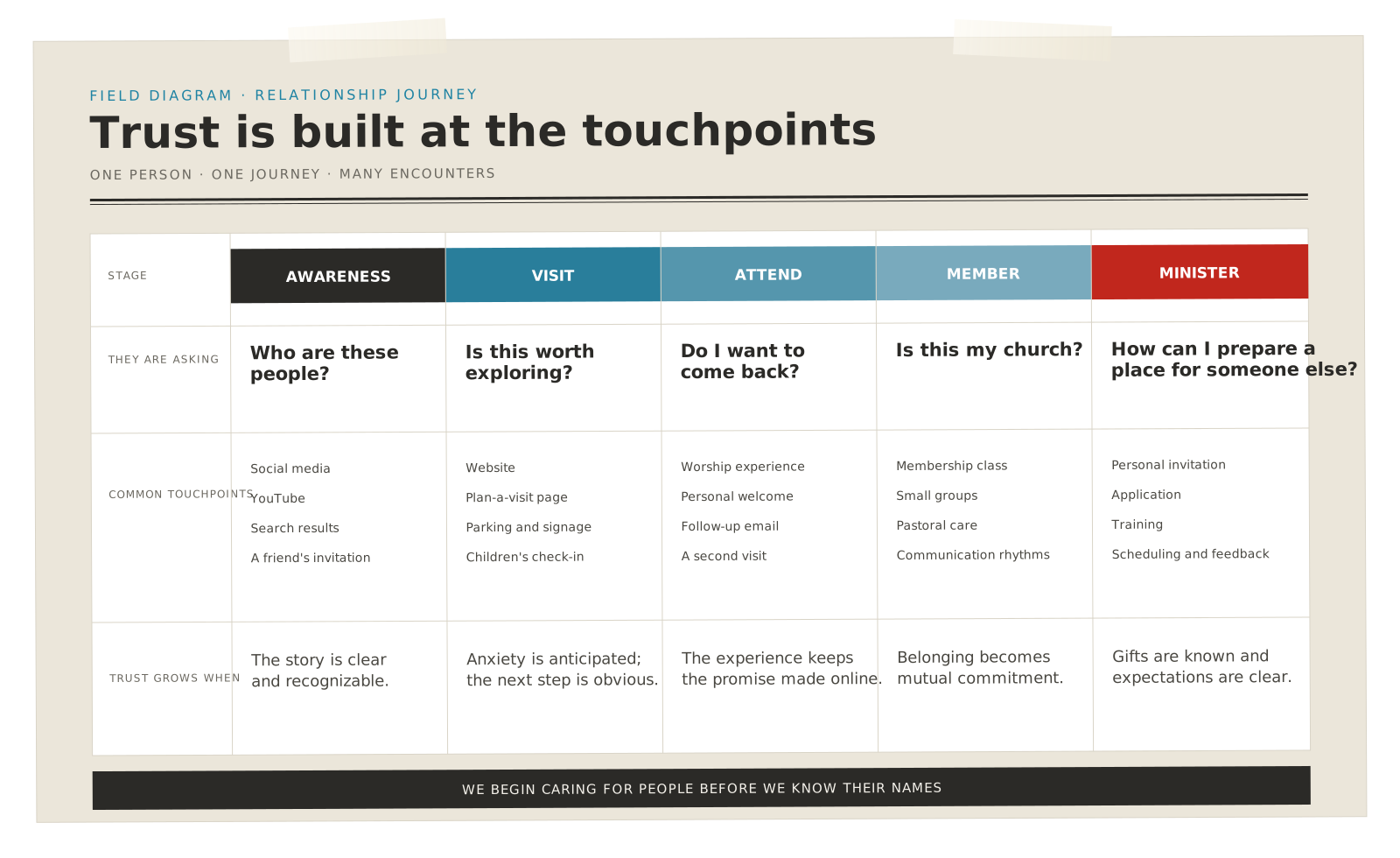
People rarely form perception from one official message. They form it across dozens of small encounters, most of them outside our direct control. Every touchpoint makes a small promise, and the next one confirms it or contradicts it. Our church may say it is welcoming; the touchpoints are what actually decide whether that is believed.
Explore the Future Congregation Journey to see how those moments can shape a path from awareness to ministry.
Which is why the useful review question is not, "Does this look right?" It is, "What will someone experience here, and does it tell the true story?"
Design is hospitality
That question, what will someone experience here, is a design question. Design is not decoration. Design is the work of solving the communication problem so the true story comes through.
And most of the time, the problem to solve is hospitality. Poor design might get someone to show up. Good design welcomes them once they arrive. An invitation says, "Come see how we live." A welcome says, "We made room for you."
Think of a grandparent preparing for a grandchild. They do not just open the door. The living room shifts. The food changes. The television habits change. They may never choose Bluey on their own, but they make room for it, because the child matters.
That is what good design does. It makes accommodations. It asks, "What will help this person feel expected, understood, and at home?" Jesus told his disciples he was going to prepare a place for them. Good design carries that same idea on a much smaller scale. It prepares a place.
Consistency is what builds trust
Every church really tells two stories. There is the story it says about itself: the mission on the wall, the values in the bulletin, the promise made from the platform. And there is the story people actually experience: the website that works or does not, the email that gets answered or does not, the next step that is clear or confusing.
People believe the second story. In 2026, nobody simply takes us at our word; they read the touchpoints to find out whether the promise is true. When the two stories agree, and keep agreeing, trust forms. When they diverge, people trust what they experienced, not what we claimed.
Trust, after all, is mostly confidence about the future: the quiet sense that you can predict how a church will treat you next time. It grows where empathy, authority, and consistency show up together, and it thins the moment one of them goes missing.
That is why consistency is not a design nicety. It is how trust is built. A Brand worth carrying is never the product of one great campaign. It is the slow accumulation of touchpoints that told the truth. Well-designed communication simply helps the promise and the experience say the same thing, clearly, again and again.
The right story, told the right way
This site is where I work these ideas out in public. The projects are evidence, not the destination. Behind every Brand, website, film, publication, system, and tool is a church trying to make a God-given story clearer.
In the post-COVID church, communication is preaching to our future congregation. For many people, the first campus they visit will be digital: YouTube, Instagram, our website, or an email in their inbox. Long before we know their names, they are learning who we are, whether they belong, and what God may be inviting them into.
That is not marketing in the thin sense of promotion. It is a generous invitation, carrying the offer to someone before they ever walk through the door. Which makes it, quietly, evangelism.
All of it comes back to the same calling: to shepherd the story God has given us to tell.
The right story, told the right way.